Anthropic's IPO prospectus: the numbers behind the $42B loss
 Allen Yan · · 8 min read
Contents
Anthropic filed for an IPO with the SEC in June 2026, confidentially. The prospectus (the S-1) has not been made public. On September 28 and 29, Reuters published three stories by Echo Wang saying it had seen the document; Anthropic declined to comment. Almost every other report since then is a retelling of those three.
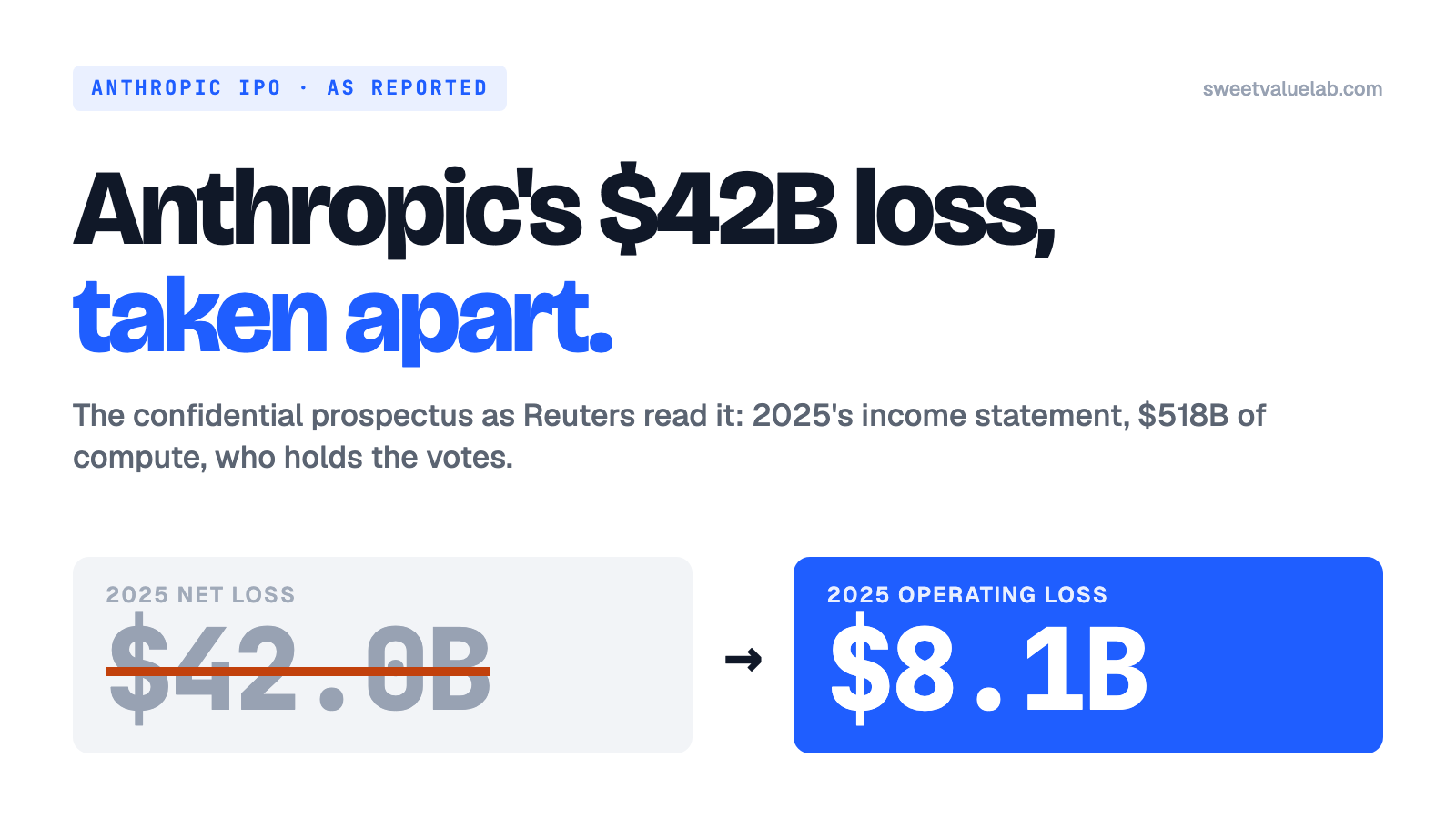
Most of the coverage stops at the headline: $4.6 billion of revenue, a $42 billion loss. This post lays the reported figures out as statements, so the pieces can be added up and checked against each other. Where a number is our own arithmetic on the reported figures, it says so.
Three labels run through the tables:
- Reuters: the prospectus, as Reuters quoted it.
- Other: independent reporting by Bloomberg, the FT or others, not from the prospectus.
- Derived: arithmetic on the reported numbers.
All amounts are US dollars. When the S-1 goes public on EDGAR, at least 15 days before the roadshow, the filed numbers replace these.
The income statement, 2024 and 2025
| US$ billions | 2024 | 2025 | Change | Source |
|---|---|---|---|---|
| Revenue | 0.386 | 4.59 | about 12× | Reuters |
| Share of revenue from two largest customers | n/a | nearly 25% | Reuters | |
| Total operating expenses | about 3.37 | 12.65 | about 3.8× | 2024 derived, 2025 Reuters |
| of which compute and infrastructure | about 2.5 | 7.33 | about 3× | 2025 Reuters, 2024 derived |
| of which everything else (people, research, sales) | about 0.87 | about 5.32 | Derived | |
| Operating loss | −2.98 | −8.06 | 2.7× wider | Reuters |
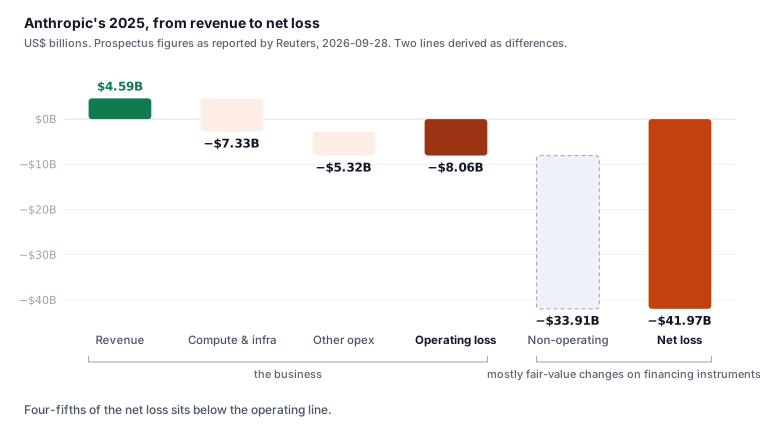
| Non-operating items (mostly fair-value changes on financing instruments) | about −5.33 | about −33.9 | Derived; Reuters says about $34B for 2025 | |
| Net loss | −8.31 | −41.97 | Reuters |
Revenue grew faster than compute spending. Compute cost about 6.6 times revenue in 2024 and about 1.6 times in 2025. The operating loss still widened, from $2.98 billion to $8.06 billion, because everything else on the expense line grew about sixfold.
Where the $34 billion came from
Reuters describes the $34 billion as the rising value of financing instruments that may later convert into Anthropic shares. When a company's valuation climbs, a claim on its future stock is worth more, and the accounting books the increase as a loss. No cash left the company for it. The higher the private valuation went during 2025, the larger this line got.
OpenAI's 2025 looks similar from the outside. The FT reported a net loss of about $39 billion there, of which about $30 billion was a comparable one-time accounting charge.
For 2024 the gap between operating loss ($2.98 billion) and net loss ($8.31 billion) is about $5.3 billion. The reports do not break it down. The same kind of instrument is the likely cause, but that is an inference.
An operating loss is also not a cash burn. None of the reports quote a cash-flow statement.
Cash on hand
Cash, cash equivalents and short-term investments were $20.28 billion on December 31, 2025 (Reuters). Total assets, total liabilities and operating cash flow were not reported.
ZeroHedge has claimed Anthropic financed more than $71 billion of Google TPUs through special-purpose vehicles and holds a $15 billion credit line. Reuters' prospectus coverage does not mention either, so treat both as unconfirmed.
2026 so far
The prospectus covers 2024 and 2025. The 2026 figures come from Bloomberg and the FT and are labelled preliminary.
| Metric | Value | Source |
|---|---|---|
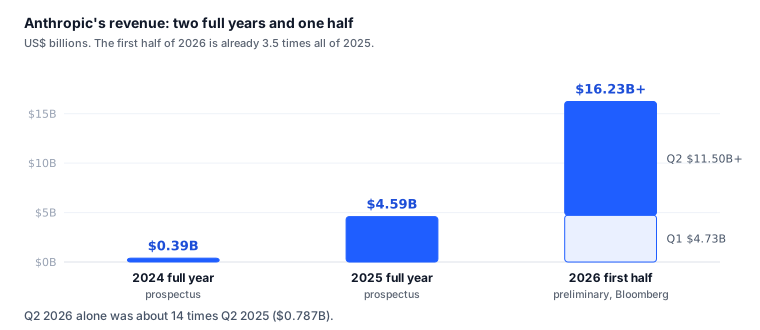
| Q1 2026 revenue | $4.73B | Other (Bloomberg) |
| Q2 2026 revenue | more than $11.5B, against $0.787B a year earlier (about 14×) | Other (Bloomberg), preliminary |
| Q2 2026 adjusted operating income | positive; one report puts it near $559M; no major outlet has confirmed that | Other (Bloomberg) |
| Q3 2026 | the FT reports it is on course for a second quarter of adjusted operating profit | Other (FT) |
| Annualized revenue run-rate | about $9B at end-2025, over $47B in May, about $65B in July | May from the company; July Other |
| Valuation | about $965B in May, about $1.5T on secondary markets, IPO target above $2T | Reuters, Other |
| Underwriters | Morgan Stanley, Goldman Sachs, JPMorgan | Other (FT) |
"Adjusted operating income" is not GAAP net income, and the adjustments have not been disclosed.
What a $2 trillion price is a multiple of
The multiple depends entirely on which revenue goes underneath it. Divide a $2 trillion valuation by each of the figures above:
| Revenue base | Revenue | $2T ÷ revenue |
|---|---|---|
| 2025 reported | $4.59B | about 436× |
| First half 2026, doubled | $32.5B | about 62× |
| Q2 2026, times four | $46B | about 43× |
| July run-rate | $65B | about 31× |
This is valuation over revenue, not enterprise value, because net cash at IPO is unknown. For scale, the 24 companies on our software board had a median EV/Revenue of 11.2× on the 2026-09-25 close, and the highest was Palantir at 77.7× with 79% revenue growth. The reverse DCF guide walks through turning a multiple like these into the growth rate it assumes.
The $518 billion of compute
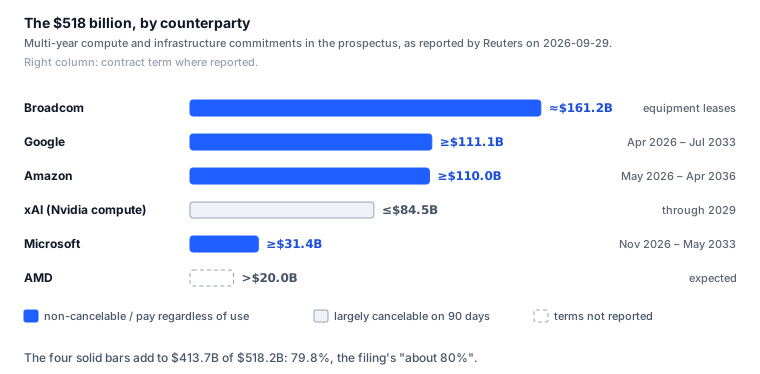
This is the number the rest of the prospectus depends on. It is a commitment to six partners spread over roughly the next ten years. Reuters' first story said "the coming year"; its follow-up the next day corrected that to multi-year contracts. The company says about 80% of it cannot be cancelled or must be paid regardless of use.
| Partner | US$ billions | Term | Cancellable? |
|---|---|---|---|
| Broadcom (equipment leases) | about 161.2 | not reported | no, except on default, for either side |
| at least 111.1 | Apr 2026 to Jul 2033 | no; shortfalls against the minimum are paid | |
| Amazon | at least 110.0 | May 2026 to Apr 2036 | no, regardless of use |
| xAI (Nvidia compute) | up to 84.5 | through 2029 | largely, on 90 days' notice |
| Microsoft | at least 31.4 | Nov 2026 to May 2033 | no, except Microsoft's uncured material breach |
| AMD | expected above 20 | not reported | not reported; AMD also committed to buy up to $5B of Anthropic stock |
The six add to about $518.2 billion. The four locked contracts (Broadcom, Google, Amazon, Microsoft) add to $413.7 billion, which is 79.8% of the total and matches the filing's "about 80%". Anthropic's stated reason in the filing is that demand for AI is constrained mainly by the supply of compute.
The same contracts, from the partners' side
This part none of the coverage did, and it matters to anyone who owns the listed partners. Divide each commitment by that company's revenue in its last full fiscal year, as filed in its 10-K:
| Partner | Commitment | Last fiscal-year revenue | Ratio |
|---|---|---|---|
| Broadcom (AVGO) | $161.2B | $63.9B (FY ended 2025-11-02) | 2.52× |
| AMD | above $20B | $34.6B (FY ended 2025-12-27) | 0.58× |
| Alphabet (GOOGL) | $111.1B | $403.0B (FY2025) | 0.28× |
| Amazon (AMZN) | $110.0B | $716.9B (FY2025) | 0.15× |
| Microsoft (MSFT) | $31.4B | $331.8B (FY ended 2026-06-30) | 0.09× |
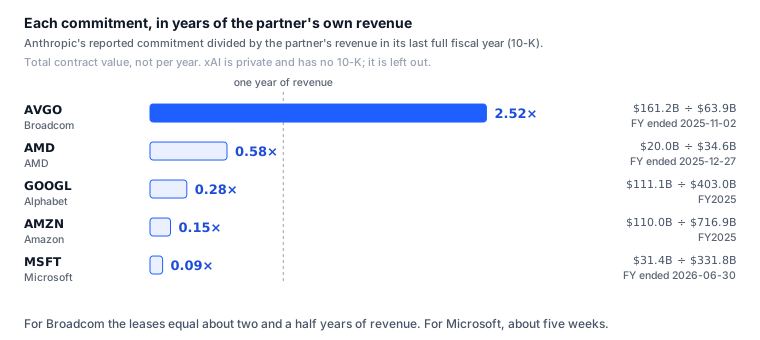
For Broadcom the leases equal about two and a half years of its revenue. For Microsoft they are about five weeks.
Where a term was reported, the contracts can be spread evenly as a rough annual figure (real contracts rarely ramp that way). Google's $111.1 billion over 7.25 years is about $15.3 billion a year, 3.8% of Alphabet's 2025 revenue. Amazon's is about $11.1 billion a year over 9.9 years, 1.5%. Microsoft's is about $4.8 billion a year over 6.5 years, also 1.5%. Broadcom's and AMD's terms were not reported, so they cannot be annualized.
xAI is private and has no 10-K, so it is left out of the comparison.
Who controls the votes: the Founder LLC
The seven co-founders together own about 14% of the company and will hold 50.1% of the vote (Reuters, Other).
- Structure. A new Founder LLC holds one Class F share carrying 50.1% of the votes. A majority of the founders decides how it votes, including on some board seats. Public Class A shares carry one vote each; shares held by strategic partners carry very little. There are five share classes in all.
- Members. CEO Dario Amodei, president and board chair Daniela Amodei, chief compute officer Tom Brown and Chris Olah, among others.
- Exit and sunset. A founder is removed on leaving, on death, on selling too many shares, or "for cause". Once two or fewer remain, the right starts to phase out.
- Public benefit corporation. Anthropic stays a PBC. The prospectus itself warns that the structure may conflict with public shareholders' financial interests.
- Pay. In 2025 Dario Amodei received about $18 million and Daniela Amodei $16.4 million, mostly in stock and options.
- Giving pledge. All seven founders have pledged 80% of their Anthropic equity to charity.
Risk factors
About 80 of the prospectus's 261 pages are risk factors, far more than a typical IPO filing (Reuters).
- Customer concentration. Two unnamed customers were nearly a quarter of 2025 revenue. Many large customers have no long-term contract and can cut spending at any time.
- Locked compute. About 80% of the $518 billion has to be paid even if demand falls short.
- AI safety. The company warns advanced AI could pose catastrophic or even existential risks, and lists behaviours models have shown or might show in testing: resisting shutdown, hiding or manipulating information, conduct resembling blackmail.
- Governance. The Founder LLC limits what public shareholders can influence.
- Government. Anthropic has clashed with the White House over how its tools may be used, and the Pentagon briefly blacklisted it until a judge stopped that in August. This is background in Reuters' story; whether the filing lists it as a risk factor was not reported.
What does not reconcile yet
- Was 2025 revenue $4.6 billion or about $10 billion? CNBC reported "about $10 billion for 2025" in August; the prospectus figure is $4.59 billion. The likely difference is gross versus net recognition of revenue sold through cloud partners, and OpenAI has accused Anthropic of using gross figures to inflate its run-rate. No report explains it. The S-1's revenue-recognition note will.
- "The coming year." Reuters' first story described the $518 billion that way. It is a roughly ten-year commitment, as Reuters' follow-up made clear.
- The 2024 gap. The $5.3 billion between operating and net loss is not broken down.
- The two customers. Neither Reuters nor the FT named them. Guesses circulating online are guesses.
The first two are the ones most likely to be quoted wrongly.
Sources
- Reuters, Anthropic's IPO prospectus shows sweeping AI vision, surging costs (via Yahoo Finance, Sep 28)
- Reuters, Anthropic's $518 billion AI buildout hinges largely on deals that cannot be canceled (via Investing.com, Sep 29)
- Reuters, Anthropic leaders to control AI lab via Founder LLC (via CNBC, Sep 29)
- TNW, Anthropic lost $42bn in 2025 and on the Founder LLC and executive pay
- TechCrunch, on the risk factors and the FT's reporting and on founder ownership and valuation
- CNBC, Q2 2026 revenue above $11.5 billion (citing Bloomberg), and TNW, Q2 revenue and underwriters
- Startup Fortune, 2024 comparisons and run-rate; Traders Agency, Google and Amazon contract terms
- ZeroHedge, on SPVs and a credit line (unconfirmed)
- Partner revenue: each company's latest 10-K, as carried on its stock page here on 2026-09-28. How those figures are read and dated is in where the numbers come from.
The weekly
The week's 13F filings, insider trades and earnings, plus new research on the site. One email a week, no account.
More posts
- Anthropic's $16.8B quarter: the investor day numbers
- What is a DCF? What a corner shop is worth
- How the 10-year Treasury moves every valuation on this site
- Delta vs United by the numbers
- Who actually owns this stock: how to read a 13F
- How to read a market sentiment gauge
- Market breadth: the index can rise while most stocks fall
- How we value a stock: twelve models, one number
- Where the numbers come from: filings, point in time
- Tesla, taken apart: a sum of the parts in three scenarios
- How to read a reverse DCF: the growth a stock price implies
- How to value a bank: P/TBV, ROTCE and the line
- How to value a REIT: FFO, P/FFO and the yield spread
- How to value a software company: Rule of 40 and SBC
- Total return vs price return: what a stock chart leaves out
- What a backtest cannot tell you